
How to Create an eBook From a TikTok Transcript
Turn your short videos into an ebook: get a TikTok transcript for each clip, sort the fragments by topic, fill the gaps and shape them into full chapters.
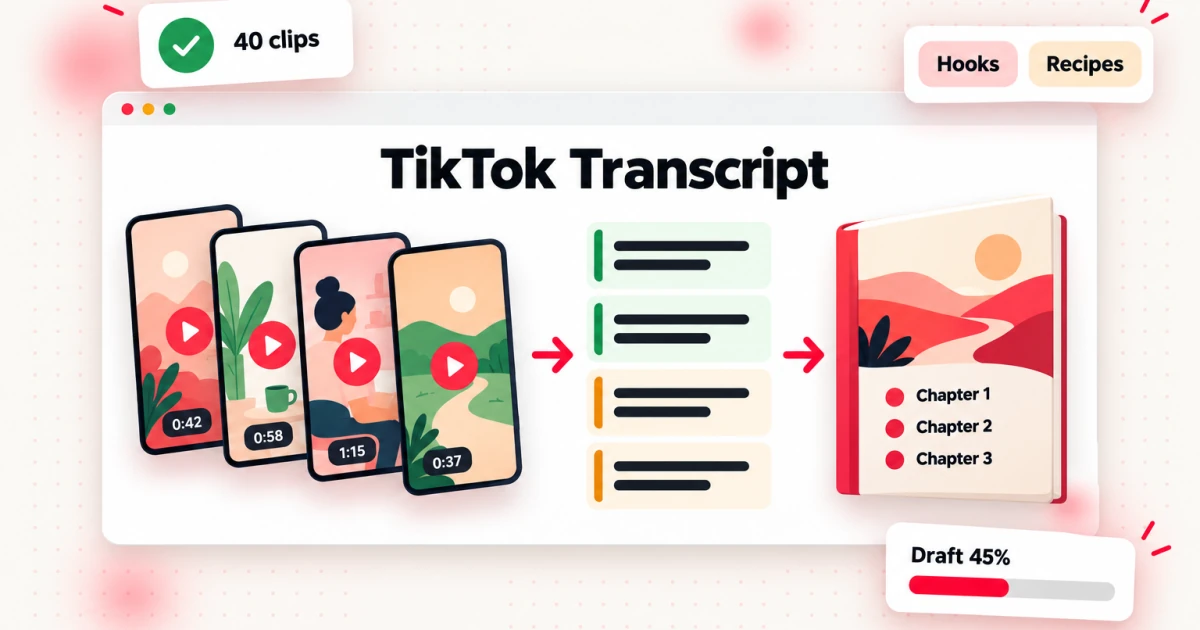
To create an ebook from your TikTok videos, get a TikTok transcript for each clip you want to use, sort the transcripts by topic, fill the gaps each TikTok video leaves, and rewrite each group into a full chapter before you export the file. A TikTok transcript is a strong starting point because it holds your hooks, tips and stories in your own words. It is also fragmented: a 45-second TikTok video transcript gives you one idea, often without the setup, the steps or the context a reader needs. The work of the book is turning dozens of fragments into chapters that hold together.
This guide is for creators who have built a library of short videos on one subject, such as recipes, fitness routines, money tips, study methods, small business advice or craft tutorials, and want a book that collects and completes it. It covers why a TikTok transcript library can become a book, the ownership question to settle first, how to collect and clean transcripts, how to sort short clips into chapters, how to expand a one-minute idea into a page, and how to export and test the finished ebook.
Why a TikTok Transcript Library Can Become a Book
A TikTok transcript is the speech in one TikTok video, written out as lines with timestamps. One transcript is small. A library of them is something else: hundreds of tested explanations of your subject, each one shaped by what made viewers stop scrolling.
That gives a book three useful things:
- Proven topics. Your most-watched and most-saved clips show which questions your audience actually cares about. Those questions are your chapter list.
- Your voice. TikTok creators usually speak more directly than they write. A transcript keeps that directness, which is hard to recreate on a blank page.
- Raw volume, in small pieces. People speak roughly 130 to 160 words a minute, so a 60-second clip holds somewhere around 130 to 160 words. A hundred clips can add up to a short book's worth of raw text, but in a hundred pieces that rarely connect on their own.
The fragmentation is the central problem, and it shapes everything below. TikTok videos are built to stand alone. Each one opens with a hook, skips the background and ends before the details. A book has to supply what the clips leave out: the order, the definitions, the full steps, the examples and the reasons. Expect to write more new text for a TikTok book than for a book made from long lectures or a YouTube playlist. If you also have long-form videos, our guide on how to create an ebook from YouTube transcripts covers that route.
Use Your Own TikTok Videos: Ownership Comes First
Only turn TikTok videos into an ebook when you own the content or have permission. The fact that a clip is public does not make its words free to publish.
TikTok's intellectual property policy says it does not allow content that infringes copyright, and that using others' copyrighted content without proper authorization or a legally valid reason may violate its policies (TikTok: Intellectual Property Policy). Book stores apply their own rules. Amazon KDP says it will not accept copyrighted content that is freely available on the web unless the copyright owner provides it (Amazon KDP: Content Guidelines). Your own public TikTok videos fit that rule when you are the owner. Someone else's do not.
TikTok adds a few traps that long-form creators meet less often:
| Clip type | Can it go in your book? | Why |
|---|---|---|
| Your original talking-head clips | Yes | Your words, your content |
| Duets and stitches | Only your half | The other creator's words belong to them |
| Clips reacting to or reading someone else's post | Usually no | The quoted material is not yours |
| Videos over a trending song or sound | Your speech only | Song lyrics are someone else's work; the transcript tool does not transcribe an attached song anyway |
| Collaborations and guest clips | Ask | Get written agreement from the other creator |
| Clips made for a brand deal | Check your contract | Brand scripts and claims may be restricted |
Fair use and fair dealing are narrow, case-by-case exceptions decided under local law. They are not a plan for a book. If you want to build a book on other people's videos, get permission in writing first.
How to Create an eBook From a TikTok Transcript: The Process
The whole process fits in seven steps:
- Audit your videos and pick a book angle. Choose one reader and one promise.
- Get a TikTok transcript for each video. One link or upload per clip.
- Download, label and clean the transcripts. Plain text, consistent names, fixed errors.
- Sort the short clips into topics and chapters. Turn a feed into a structure.
- Fill the gaps short videos leave. Expand ideas into complete explanations.
- Draft the chapters in Bookeen. Use the transcripts as source material.
- Edit, export and test the ebook. Read it through and check the files.
If you are new to ebooks in general, our guide on how to create an ebook covers formats, covers and publishing in depth. This guide focuses on what is different when your material is a TikTok transcript library.
Step 1: Audit Your TikTok Videos and Pick a Book Angle
TikTok creators usually post more than they remember. Before collecting anything, export or note down your video list and look at it as a whole.
Sort your clips into rough piles by subject. Most niches split into a few clear groups. A home cook might find "weeknight dinners", "baking basics", "kitchen tools" and "meal prep". A personal finance creator might find "budgeting", "debt", "saving", "investing basics" and "money mistakes".
Then pick one pile, or two closely related piles, and write a promise in one sentence: "This book helps [reader] [get a result] using the methods from my videos." That sentence is your filter. A book that tries to cover every pile becomes a scrapbook.
Good signs that a pile can become a book:
- Twenty or more clips on the same subject, ideally with some that went deeper than a single tip.
- A natural order. Beginners need A before B. Recipes go from simple to advanced. Workouts build week by week.
- Repeated questions in your comments. If people keep asking the same thing, a book can answer it properly.
- Methods, not trends. Advice that still works next year makes a better book than reactions to this month's news.
Write the final clip list in a spreadsheet with columns for the link, the topic, a one-line summary and the view count. You will add more columns as you go.
Step 2: Get a TikTok Transcript for Each Video
A TikTok transcript generator does the collecting for you. On the TikTok transcript page of transcript.im, you paste a public tiktok.com video link on the Link tab, or upload a clip you already saved on the Video, Audio tab. If the creator published captions, those are read first; if the video has none, the speech is transcribed. The lines come back with timestamps that follow the voice.
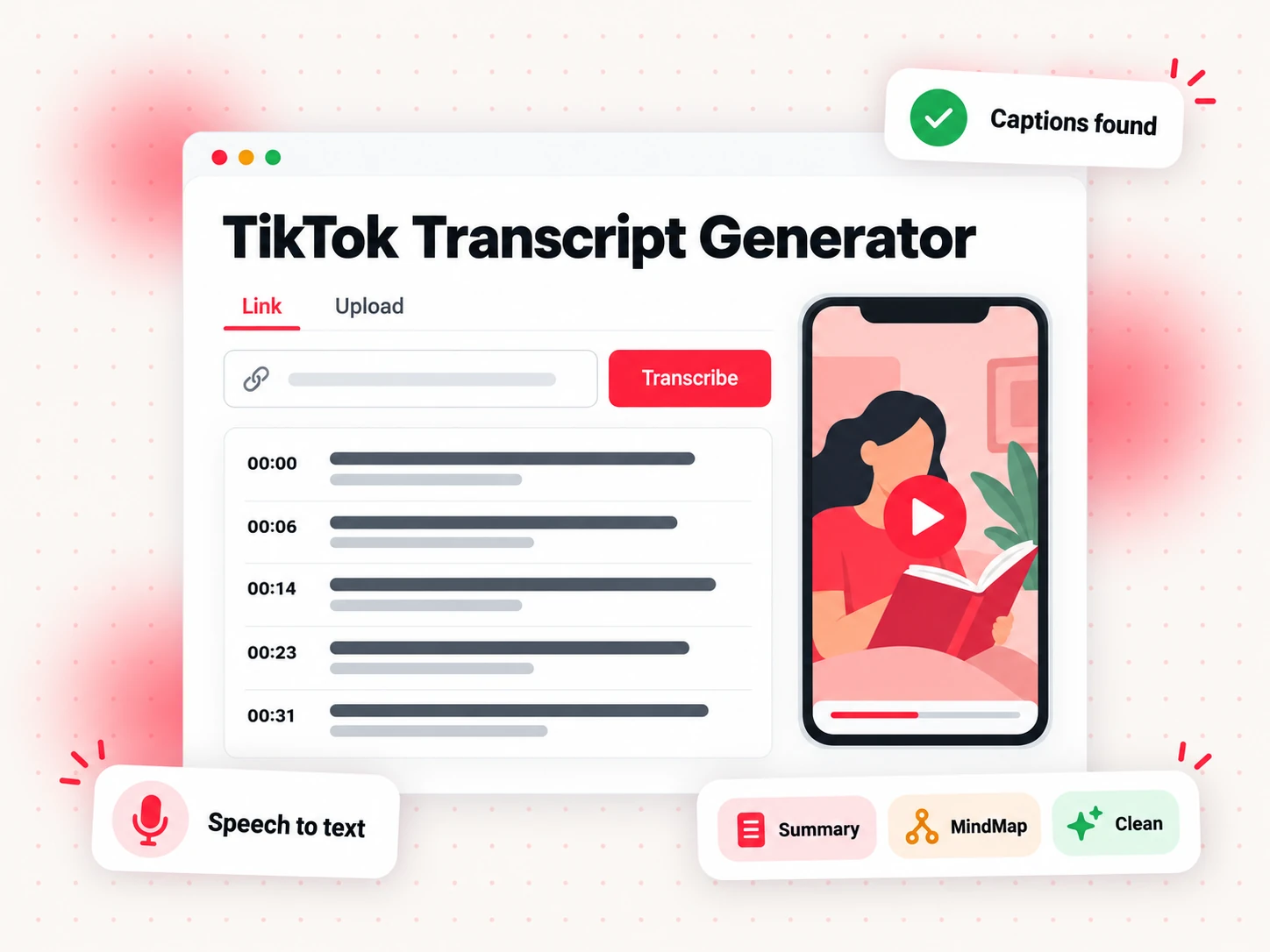
Two details matter for book work. First, the TikTok transcript generator reads speech, not lettering drawn into the picture, so if a clip relies on on-screen text for its key steps, note those steps by hand. Second, a song attached as the video's sound is not what gets transcribed, so a voiceover over music still comes back clean, and a clip with no speech returns little text.
Once a TikTok video transcript is ready, you can search it, copy a line with its timestamp, or open Summary, Core Points and MindMap on the same text. For a book, the most useful habit is to run through a batch of transcripts and copy each clip's core point into your spreadsheet next to its link. That one line per clip is what you sort in Step 4.
Because each TikTok transcript is collected one clip at a time, start with your strongest twenty or thirty clips rather than your entire account. You can always add more once the outline exists and you know what is missing.
Step 3: Download, Label and Clean the Transcripts
For a manuscript, a TikTok transcript download as a TXT file is the right format. TXT keeps the words and drops the timing codes that SRT and VTT caption files carry for video editors. Those caption formats are still useful if you want subtitles for your next video, but not for a book.
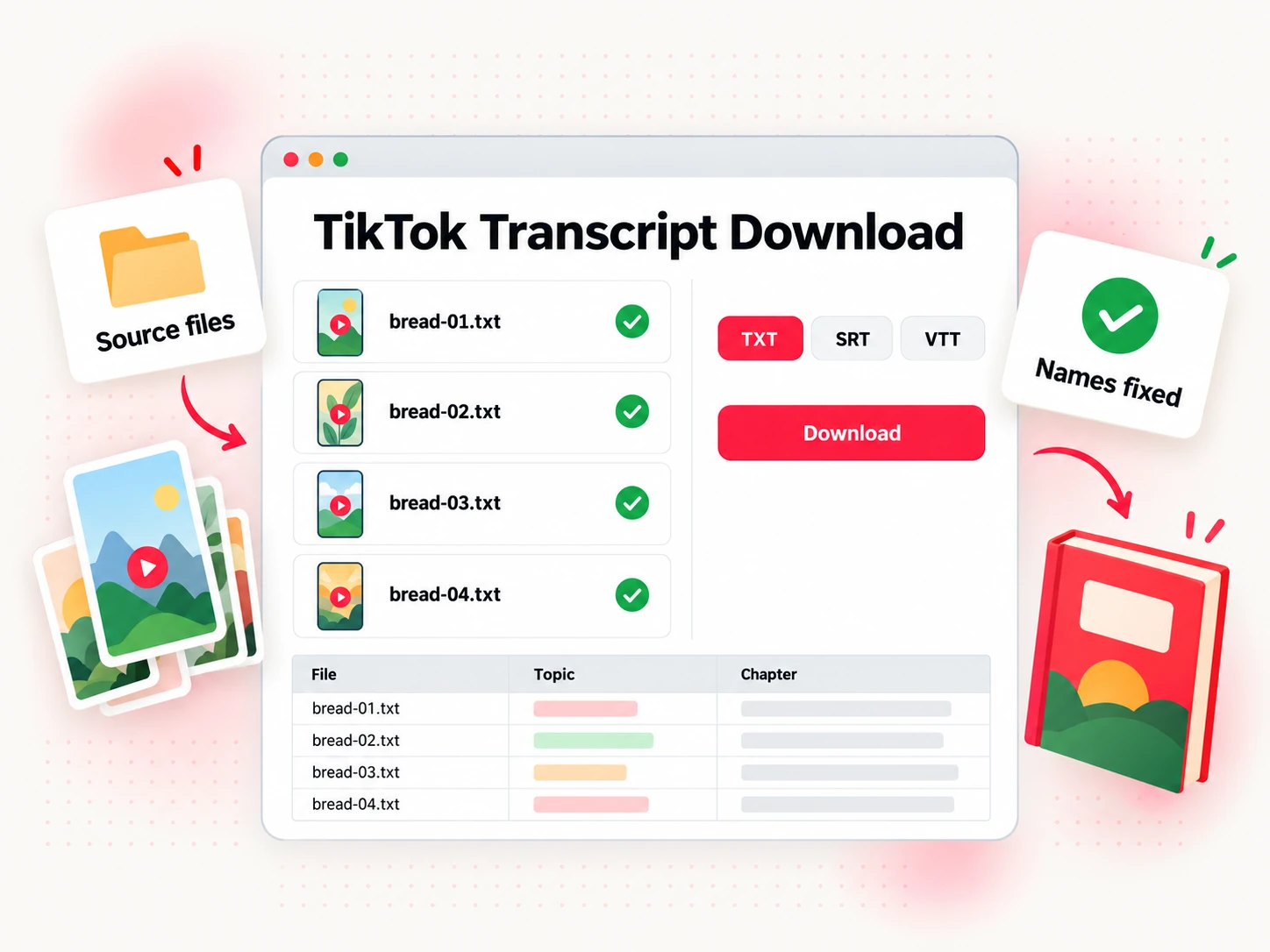
Name every file so you can find it later. A pattern such as bread-07-shaping.txt tells you the topic, the order and the content at a glance. Add the file name to your spreadsheet row.
Then clean each file once, before any rewriting:
- Fix names and terms. Transcription is reliable on everyday words and weaker on brand names, ingredient names, exercise names and slang. transcript.im also has a Clean step that can repair misheard words without dropping the timestamps, but read the result yourself.
- Check numbers. Grams, reps, prices, percentages and temperatures must be right in a book, because a reader will follow them.
- Remove the platform talk. Cut "follow for part two", "link in bio", "stitch this", greetings and calls to action. None of it belongs in a book.
- Mark what was on screen. If a clip said "do this" while showing a movement or a technique, add a note such as
[SHOWN: fold dough in thirds]so you remember to write it out. - Delete other people's words. Remove the other half of duets, quoted posts and any lyrics.
After the TikTok transcript download and the cleaning pass, you should have one clean text file per clip and a spreadsheet that lists them all.
Step 4: Sort the Short Clips Into Topics and Chapters
This is the step that turns a feed into a book. A TikTok account is ordered by date. An ebook is ordered by what the reader needs next.
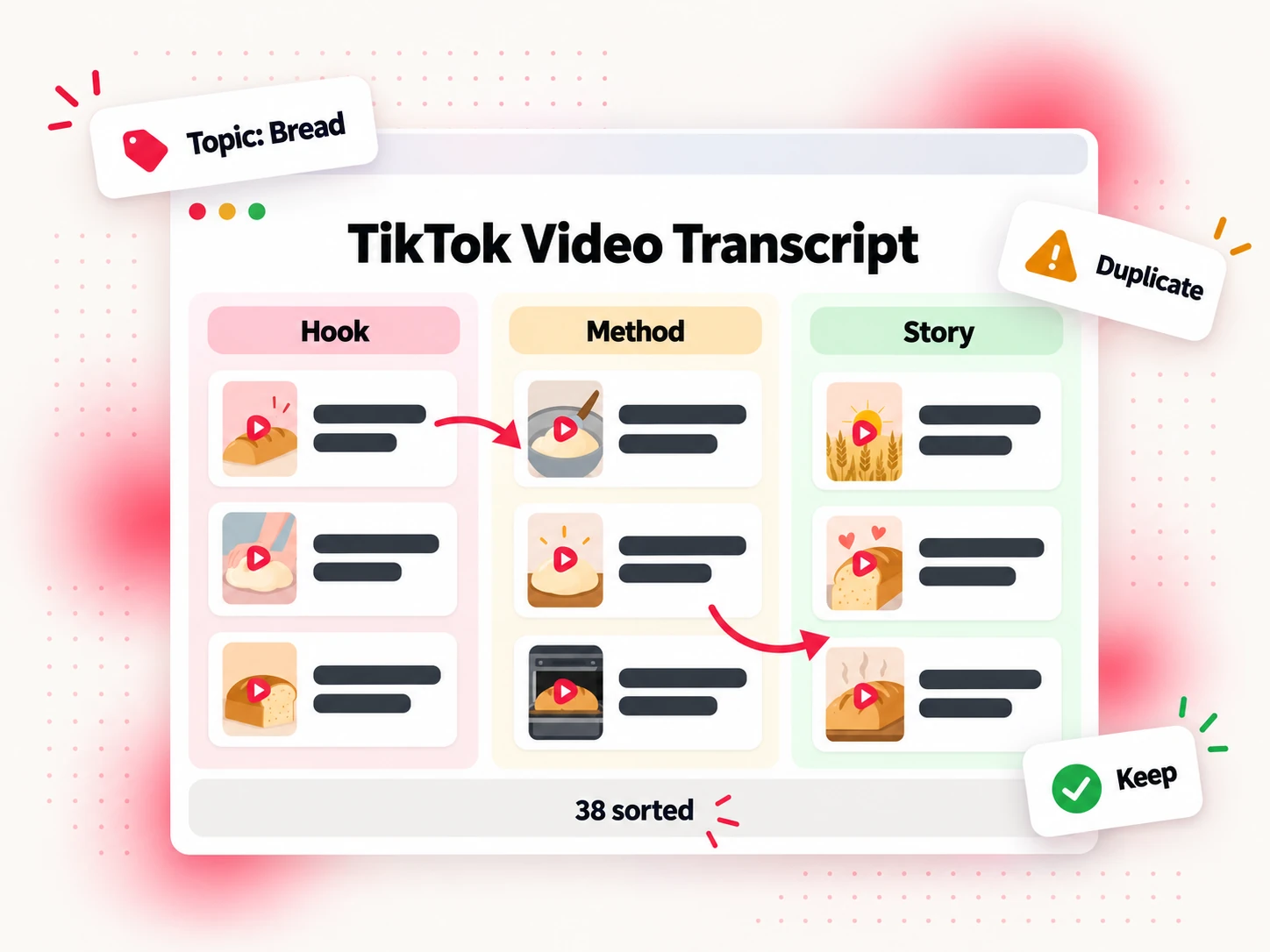
Work from the one-line core points in your spreadsheet, not from each full TikTok transcript, so you can see the whole library at once. A simple method:
- Tag every TikTok video transcript by role. Most clips are one of four kinds: a method (how to do something), a story (what happened to you or a client), a myth or mistake (what people get wrong) or a hook (a bold claim or question with little substance behind it).
- Group methods into chapters. Each chapter should answer one question a reader would ask. Five clips on shaping bread become one chapter on shaping.
- Attach stories and mistakes to chapters. Stories become examples inside a chapter. Mistakes become a "what to avoid" section at the end of it.
- Use hooks as openings, not content. A strong hook can open a chapter in one or two sentences. On its own it cannot fill a page.
- Flag duplicates. Creators often make the same point many times. Keep the clearest version and the best example, and mark the rest as duplicates.
- Put the chapters in teaching order. Basics first, then techniques, then troubleshooting, then advanced topics.
When you finish, write the table of contents. Next to each chapter, list the clips that feed it and the questions it still cannot answer. Those open questions drive Step 5. If you want help spotting themes across dozens of transcripts, NotebookLM accepts text file uploads and answers questions across them with a citation to each passage; our guide on what NotebookLM is used for shows how writers use it.
Step 5: Fill the Gaps Short Videos Leave
A TikTok video transcript skips what a book cannot. Moving from TikTok to text means writing the missing parts, and for most TikTok books this is the largest single job.
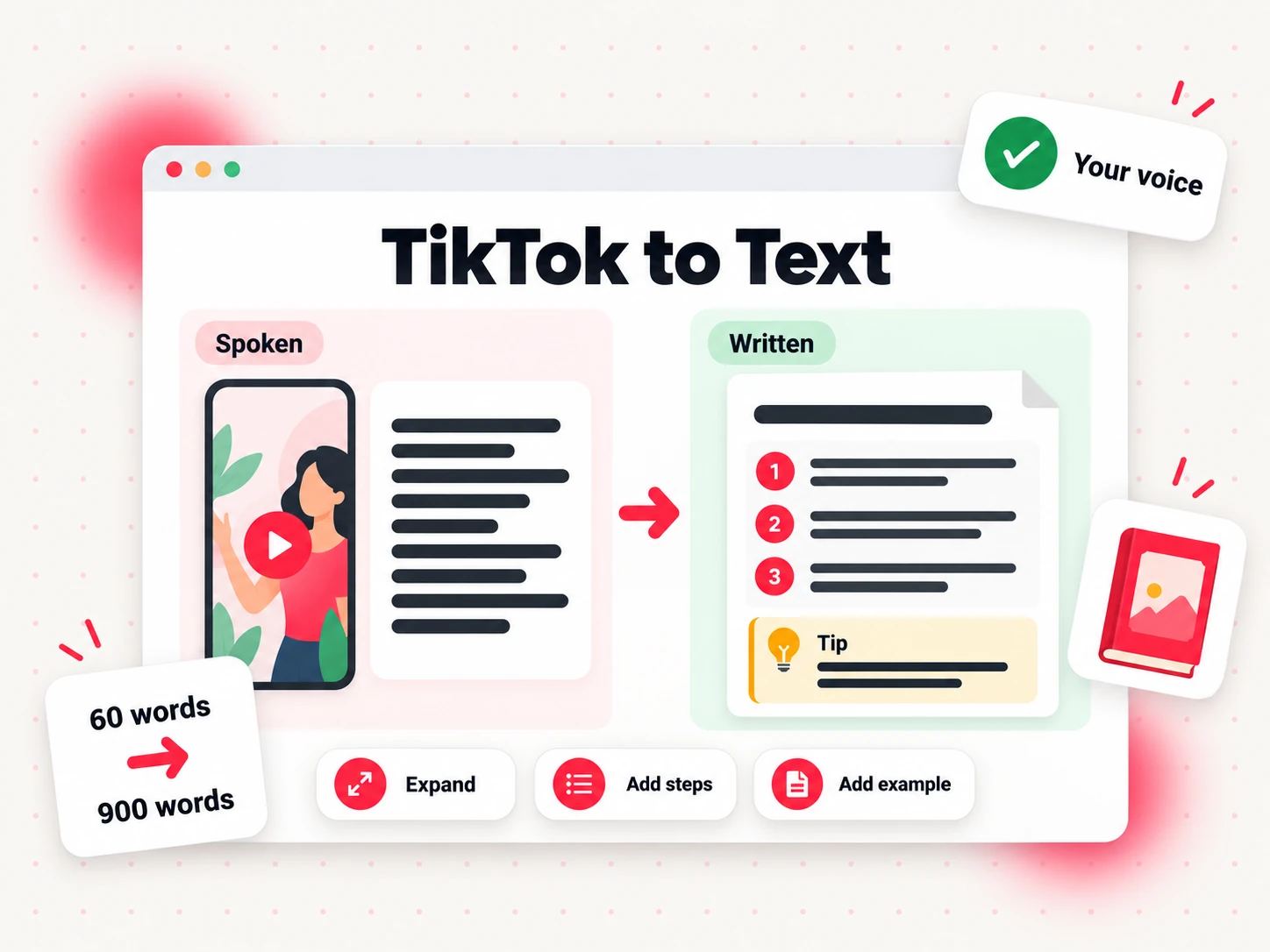
For each chapter, check what the clips leave out:
| What the clip does | What the chapter needs |
|---|---|
| Opens with a hook | A short introduction saying what the chapter covers and who it is for |
| Shows one tip | The context: when to use it, when not to, and why it works |
| Skips the basics | Definitions and the setup a beginner needs first |
| Shows a technique on screen | Every step written out, numbered, in order |
| Gives a quick result | A worked example with real quantities from start to finish |
| Ends with "part two coming" | A complete ending: a summary or checklist |
A useful rule of thumb when going from TikTok video to text: a one-minute clip becomes a section of several hundred words once you add the setup, the steps, an example and the limits. A chapter usually draws on several clips plus new writing. If a chapter is short, the gap is usually in the steps or the example, not the introduction.
Keep your voice while you expand. The direct, conversational style that works on TikTok can work on the page too, as long as the sentences are complete and the steps are in order. Do not smooth everything into formal prose; readers who know you from your videos should recognize you.
One more check from the store side: KDP's content quality guide lists content whose primary purpose is to solicit or advertise, and content that sends readers to an external source to get the full content, among the things it does not allow (Amazon KDP: Guide to Kindle Content Quality). A book that keeps saying "watch my video for the rest" fails that test. Every chapter should be complete on the page.
Step 6: Draft the Chapters in Bookeen
With the outline, the cleaned transcripts and your gap notes ready, you can develop the manuscript in Bookeen, an AI online book creator. The transcripts serve as source material for chapters you shape, not as text to paste in unchanged.
- Start with a brief. Describe the book in a sentence or two, using your promise from Step 1. Bookeen turns it into a book brief with the topic, reader and intended length, and you can edit it before any chapter is written.
- Choose a book type. For most TikTok niches, How-To Guide is the natural fit. Lead Magnet suits a short book you give away to grow your audience. Interactive Workbook suits fitness, study and habit content where readers fill things in.
- Attach the sources for each chapter. Bookeen accepts text attachments such as TXT, Markdown, PDF and HTML in a project session, so the TXT files from Step 3 can go in as they are. Attach the transcripts that feed one chapter, with your outline and gap notes, rather than the whole library at once.
- Develop, read and revise. Ask for one chapter at a time, built from the attached transcripts and notes. Change and regenerate sections until each chapter is complete and sounds like you. Bookeen drafts; you are the author and responsible for every fact.
- Write what only you know. Personal stories, results from your own practice and safety warnings in your niche should come from you, and they should be checked with extra care.
If you publish on Amazon KDP, keep track of which content was AI-generated: KDP asks you to disclose AI-generated text, images and translations when you publish, while content you wrote and only edited or refined with AI tools counts as AI-assisted and does not need to be disclosed (Amazon KDP: Content Guidelines).
Step 7: Edit, Export and Test the eBook
Read the whole draft in order, ideally on a phone. Books built from short clips have predictable faults: the same tip appears in three chapters, a chapter refers to "the video" that the reader cannot see, or a technique depends on a step explained only in a later chapter. Fix those first.
Then export. Bookeen exports Word (DOCX), PDF for reading, EPUB, PDF for print, a cover image, a print cover and Markdown. EPUB reflows to fit phones and e-readers, which suits a text-led guide. Add a PDF when readers will print checklists, meal plans or workout logs.
Before you share or upload the file, validate the EPUB with EPUBCheck and fix every error it reports. Then open it on a phone, a tablet and an e-reader if you have one. Check the table of contents, the headings, any images and how your checklists look on a small screen.
When the files pass, decide where the book goes. Many TikTok creators start by offering the book to their audience directly, then add stores later. If you export a PDF, a PDF to video tool such as Potto can turn a sample chapter into a narrated MP4 with captions, which gives you a teaser to post alongside the launch. Our guide on where to sell ebooks compares channels, and how to publish a book on Amazon walks through KDP. Bookeen does not upload to stores for you; you publish the files yourself. For the wider plan after launch, from store listings to publishers and an email list, see how to sell books.
What Kind of eBook Fits Your TikTok Niche
Different niches produce different books. Matching the book type to your content saves a lot of rewriting.
| Niche | Book it becomes | What the clips provide | What you add |
|---|---|---|---|
| Recipes and cooking | Recipe collection or technique guide | Methods, tips, your personality | Full ingredient lists, quantities, timings, a shopping list |
| Fitness and wellness | Program or workbook | Exercises, cues, motivation | Week-by-week plan, progressions, safety notes, logs |
| Personal finance | How-to guide | Rules of thumb, myths, stories | Definitions, worked numbers, checklists, local caveats |
| Study and productivity | Workbook | Techniques, routines | Templates, exercises, a schedule readers can follow |
| Small business | Playbook | Lessons learned, mistakes | Step-by-step processes, scripts, decision tables |
| Crafts and DIY | Project book | Techniques shown on screen | Written steps, materials lists, diagrams |
| Storytime and life lessons | Memoir or essay collection | Stories in your voice | Structure, connective chapters, a through-line |
If your niche relies mostly on visuals, such as makeup, fashion or dance, a text-led ebook will need diagrams or a fixed-layout PDF, and it may suit a short lead magnet better than a full book. For simple step illustrations, an AI image generator such as Potto can draft images from a text prompt and reference photos; check that every step it shows matches what you actually teach. If you post the same clips as Instagram Reels, the process is the same, and our guide on how to create an ebook from Instagram transcripts covers what changes.
A Worked Example: Forty Sourdough Clips to a Starter Guide
This is an illustrative example rather than a real account, but the numbers are realistic.
A creator has posted about 250 baking videos over two years. Around 60 are about sourdough. They want a beginner guide called, for the sake of the example, "Your First Sourdough Loaf".
Audit
The promise: "This book helps a beginner bake a good sourdough loaf at home in their first month." Forty of the 60 sourdough clips fit. The others are trend reactions and duets with other bakers, which they drop.
Collect
They get a TikTok transcript for each of the 40 clips, one link at a time, and copy each clip's core point into a spreadsheet. Six clips rely on on-screen text for the recipe amounts, so they note those amounts by hand.
Clean
They download each TikTok transcript as TXT, name the files bread-01 to bread-40, fix flour names and hydration percentages, and cut every "follow for part two".
Sort
The 40 clips become 8 chapters: starter, ingredients and tools, mixing, folding, shaping, proofing, baking, and troubleshooting. Eleven clips are duplicates of the same point and only the clearest is kept. Seven story clips become examples. Five myth clips become a "what to avoid" box at the end of chapters.
Fill
Each chapter gets an introduction, written steps for everything that was shown on screen, one full worked bake with weights and times, and a checklist. Two chapters are written new because no clip covered them: "Reading your kitchen's temperature" and "A weekly baking schedule".
Draft and export
In Bookeen they use the How-To Guide type, attach the transcripts and notes chapter by chapter, revise each one, and export EPUB and PDF. EPUBCheck reports one error, which they fix. The PDF version goes out first to their audience with a printable baking log.
The finished guide uses fewer than a quarter of the creator's videos and a lot of new writing. That is normal. The TikTok transcript library supplies the voice and the proven topics; the ebook supplies the order and the completeness.
A Chapter Template for Books Built From Short Videos
Use this outline for each chapter. It forces the gaps into the open.
- Opening (2–3 sentences). What the chapter helps the reader do, often adapted from your best hook on the topic.
- Why it matters. The problem this solves, in a short paragraph.
- What you need. Tools, ingredients, materials or prerequisites, as a list.
- The steps. Numbered, complete, with every on-screen action written out.
- Worked example. One real case with numbers, start to finish.
- Common mistakes. Drawn from your myth and mistake clips.
- Checklist or summary. What the reader should be able to do now.
When a section of the template stays empty after you have used all the relevant transcripts, that empty section is exactly what you need to write new.
Common Mistakes When Turning TikToks Into an eBook
Pasting transcripts in date order
A feed is not a structure. Sort by topic and teaching order first.
Keeping every repeat
TikTok creators repeat their best points on purpose. A book should say each one once, well.
Leaving the hooks as content
A bold opening line is not a chapter. Give it substance or cut it.
Forgetting on-screen text
If the amounts, steps or labels were drawn on the video, the transcript does not have them. Add them by hand.
Including other creators' words
Duets, stitches and reaction clips carry someone else's content. Leave it out unless you have permission.
Pointing readers back to the app
"Watch my video for this step" makes an incomplete book. Write the step.
Publishing without checking the facts
Whether you expand by hand or with AI help, check every quantity, claim and safety note before release.
TikTok Transcript to eBook FAQs
What is a TikTok transcript?
A TikTok transcript is the speech in a TikTok video written out as lines with timestamps. It is separate from the caption overlay drawn on the video, and it is text you can read, search, copy and reuse. For a book, it is raw material you sort, expand and rewrite.
How do I get a TikTok transcript for my videos?
Use a TikTok transcript generator. On transcript.im, paste a public TikTok link on the Link tab of the TikTok transcript page, or upload a clip you saved. It reads captions when they exist and transcribes the speech when they do not.
Can I get a transcript of a TikTok video that has no captions?
Yes. When a TikTok video has no captions, the transcript tool transcribes the speech instead. Lettering drawn into the picture and an attached song are not transcribed, so add any on-screen text by hand.
Which format should I use for a TikTok transcript download?
Use TXT for a book. A TikTok transcript download as TXT gives you plain text without timing codes. SRT and VTT are caption formats meant for video players and editors.
How many TikTok videos do I need to make an ebook?
It depends on how deep the clips go. Twenty to forty focused clips on one subject can support a short guide, as long as you add new writing for the gaps. Expect to write a large share of the book yourself, because a TikTok video transcript leaves out setup, steps and examples.
Can I turn someone else's TikTok videos into an ebook?
Not without permission. TikTok's policy does not allow using others' copyrighted content without authorization, and KDP will not accept copyrighted content freely available on the web unless the owner provides it. Use your own videos or get written permission.
Is a TikTok transcript accurate enough to publish as is?
No. Transcription makes mistakes with names, slang and numbers, and a TikTok video transcript usually leaves out context. Clean and check every TikTok transcript, then rewrite it into complete chapters.
Can AI help turn TikTok transcripts into a book?
Yes. An AI book tool such as Bookeen can develop chapters from your attached transcripts and notes, but you still check every fact, fill in personal details and edit for your voice. Disclose AI-generated content if a store such as Amazon KDP requires it.
Turn Your Short Videos Into a Book With Bookeen
Each TikTok transcript you own already holds the tips and stories your audience came for. Collect them with the TikTok transcript tool on transcript.im, sort and complete them, and develop each chapter in Bookeen until the book works without the videos.