

How Many Words in a Novel? Word Counts by Genre
How many words in a novel, novella and short story, typical word counts by genre, how words turn into pages, and how long a debut novel should be.
How many words in a novel? Most adult novels land between 70,000 and 100,000 words, and the figure agents and editors quote most often is 80,000 to 90,000. The formal floor is much lower: the Science Fiction and Fantasy Writers of America (SFWA) treats anything of 40,000 words or more as a novel. Your novel word count decides which of those two numbers matters to you. A first book sent to literary agents is judged against the narrow commercial range. A book you publish yourself is judged mostly by readers, and by what a printer charges for each page.
This guide gives you both sides. It shows where short stories, novellas and novels begin and end, the typical word count for each genre, and how a word count turns into printed pages. It covers nonfiction books, debut novels versus self-published novels, how to check your own count, and what to do when the number is wrong. Every figure comes with a source, and where sources disagree you get the range.
How Many Words in a Novel? The Short Answer
A novel is a work of fiction of at least 40,000 words by the most widely cited formal definition, and a typical published adult novel runs 70,000 to 100,000 words. Those are two different questions. The first asks where the category starts. The second asks what the market expects.
Novel: 40,000 words or more
— Science Fiction and Fantasy Writers Association, Nebula Rules
The formal definition comes from SFWA, the organization behind the Nebula Awards. Its Complete Nebula Awards Rules, effective for the award year beginning January 1, 2026, divide fiction by length like this (all figures and sources below are as of October 2026):
| Category | Word count (SFWA) |
|---|---|
| Short story | Fewer than 7,500 words |
| Novelette | 7,500 to fewer than 17,500 words |
| Novella | 17,500 to fewer than 40,000 words |
| Novel | 40,000 words or more |
These cut-offs exist to sort award entries. They are not a legal standard. Other sources draw the lines elsewhere: a 2007 Writer's Digest article put novellas at 30,000 to 50,000 words and described novels as running from 55,000 to 300,000. When you see a different cut-off in a blog post, the author is probably using a different convention.
The market range is narrower. Writer's Digest calls 80,000 to 89,999 words the ideal range for adult commercial and literary novels and 71,000 to 109,000 the safe one (Writer's Digest, 2016). The London literary agency Mushens Entertainment says the vast majority of books it sees fall into the 80,000 to 100,000 bracket (Mushens Entertainment).
So the short answer to how many words in a novel has two parts: above 40,000 words your book is a novel by SFWA's definition, and between about 70,000 and 100,000 it looks like what most readers, agents and editors expect from adult fiction.
How Long Is a Novel in Words and Pages?
So how long is a novel in pages? An 80,000-word novel is roughly 270 printed pages at 300 words per page, and about 320 pages at 250. Page count depends on trim size, type size, line spacing and how much white space the book has, so the conversion is always an estimate.
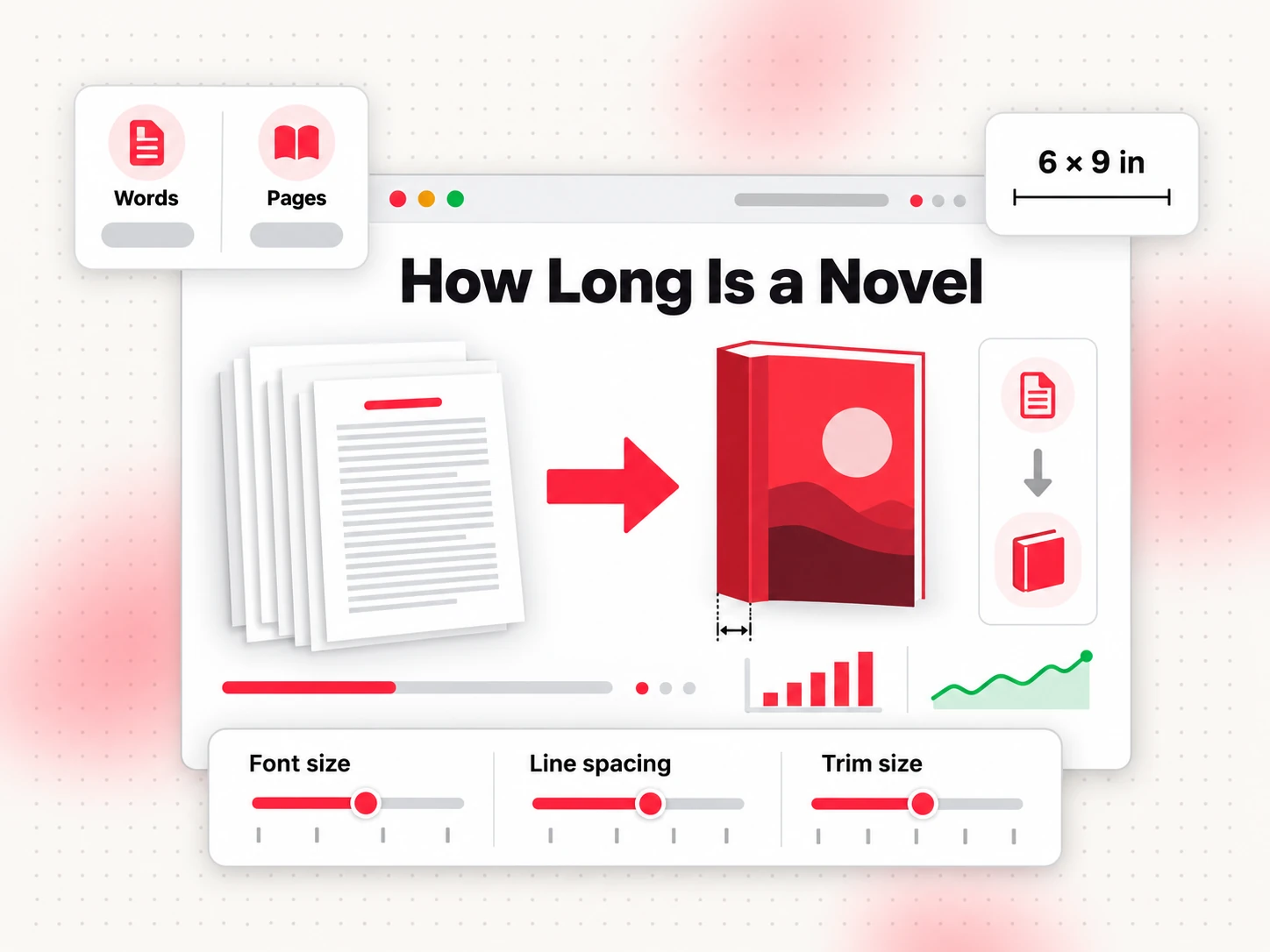
Two page counts get confused here, so keep them apart:
- A manuscript page is a double-spaced sheet in a 12-point typeface. The convention is about 250 words per page, and the word counter uses 250 as its default page size.
- A printed page is a page in the finished book. A guide from the self-publishing site selfpublishing.com puts a published book at about 300 words per page on average, and notes that dialogue-heavy text and generous formatting lower it.
Here is how common novel lengths convert, using those two rules of thumb:
| Word count | Manuscript pages (250 words) | Printed pages (300 words) |
|---|---|---|
| 40,000 | 160 | 133 |
| 60,000 | 240 | 200 |
| 80,000 | 320 | 267 |
| 100,000 | 400 | 333 |
| 120,000 | 480 | 400 |
Treat the printed column as a planning figure. A 6 × 9 inch paperback set in a large type size with wide margins and many short paragraphs runs longer than the table suggests, and a compact edition in smaller type runs shorter. You find the real number only when the interior is laid out, so do not put a page count into a cover or a price calculation until the final file exists.
Amazon KDP sets page limits for print, not word limits. As of October 2026, its print options page lists paperbacks from 24 pages up to 828 pages depending on trim size and ink type, and hardcovers from 75 to 550 pages. A 100,000-word novel fits comfortably inside both. An epic of 300,000 words printed at 300 words per page would be about 1,000 pages, which is above the paperback ceiling and would have to be split into volumes.
E-books have no fixed page count. A Kindle edition reflows to the reader's font size and screen, so the same 80,000 words is a different number of screens on every device. Amazon measures reading in Kindle Edition Normalized Pages (KENP), which it calculates from standard settings so the number does not depend on the reader's device (KDP KENPC help). Plan the book in words and let the page count follow.
Reading time is the other conversion readers care about: at the 260 words per minute that the word counter uses for fiction (an average for English-speaking adults from Brysbaert, 2019), 80,000 words takes about five hours.
Average Novel Length by Genre
The average novel length by genre runs from about 50,000 words for contemporary young adult books to 120,000 or more for epic fantasy, with most adult genre fiction between 70,000 and 100,000 words. The ranges below come from two or three independent sources per row; where only one source covers a genre, the table says so.
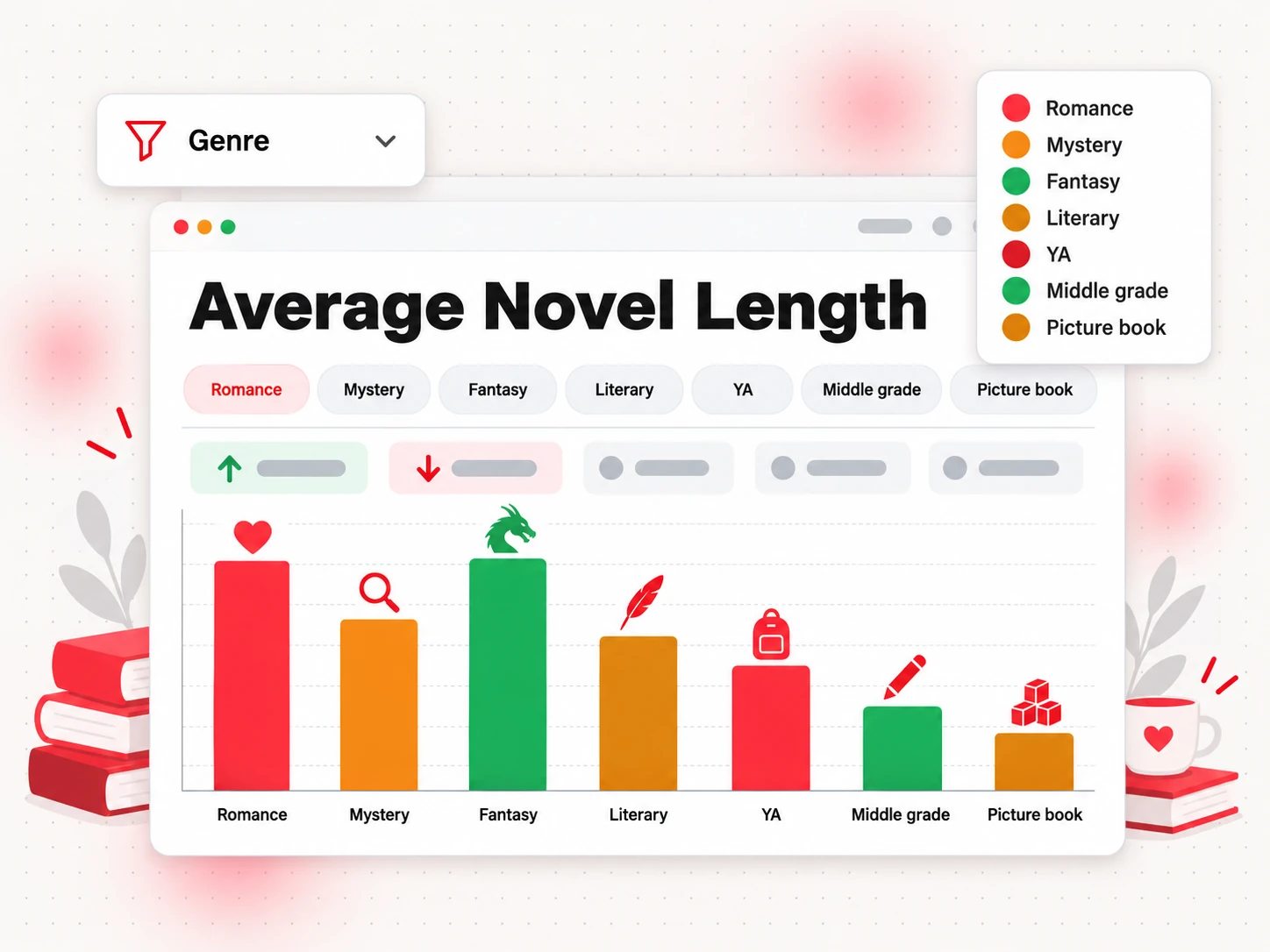
| Genre | Typical word count | Sources |
|---|---|---|
| Literary and commercial fiction | 70,000 to 100,000 (ideal 80,000 to 90,000) | Writer's Digest, Mushens |
| Romance | 70,000 to 100,000 | Mushens, selfpublishing.com |
| Mystery, crime and thriller | 65,000 to 100,000 | Mushens, selfpublishing.com |
| Science fiction | 80,000 to 125,000 | Writer's Digest, selfpublishing.com |
| Fantasy | 90,000 to 125,000, epic fantasy 120,000 and up | Writer's Digest, Mushens |
| Historical fiction | 100,000 to 120,000 | Mushens (one agency's guideline) |
| Young adult (YA) | 50,000 to 80,000, YA fantasy longer | Writer's Digest, Mushens |
| Middle grade | 20,000 to 55,000 | Writer's Digest, selfpublishing.com |
| Picture books | About 500 to 600, and rarely above 1,000 | Writer's Digest (one source) |
These are guidelines for finished, edited manuscripts. The Writer's Digest guide, published in October 2016, is the oldest source here. The Mushens page is an undated agency blog post, and the selfpublishing.com guide is dated July 27, 2026. Where the three overlap, they agree closely, which is why the table gives ranges rather than exact numbers. Where the sources differ, as with mystery, the table spans both.
So how many words in a novel of your genre? The usual reasons the ranges differ come down to what readers expect:
- Fantasy and science fiction run long because the author has to build a world before the plot can move. Readers of epic fantasy expect that scale. Mushens puts epic fantasy at 120,000 to 150,000 words or more, and says its longest debut was around 160,000 words.
- Romance and mystery run tighter because the genre promise is a single engine, a relationship or a puzzle, and padding slows it down.
- Historical fiction runs long because period detail and a wider cast take space.
- Young adult and middle grade run shorter because the readers are younger and the story is usually told from one point of view. Contemporary YA sits near 50,000 to 80,000 words, and middle grade sits at 20,000 to 55,000.
- Literary fiction has the widest spread, since the prose style decides the length more than a genre promise does.
One thing to take from the table is what a miss looks like. A book far above its genre range can read as unedited, which is how the agency Mushens describes submissions of 200,000 words or more. A book far below it can read as unfinished, or as a different product such as a novella. Use the table as a range to aim at, not a quota: when you ask how many words in a novel like yours, the answer is the band your genre's readers already buy.
How Many Words Is a Novella?
A novella is a work of fiction of 17,500 to fewer than 40,000 words by SFWA's definition, so how many words is a novella comes down to roughly 17,500 to 40,000. That is about 60 to 135 printed pages.
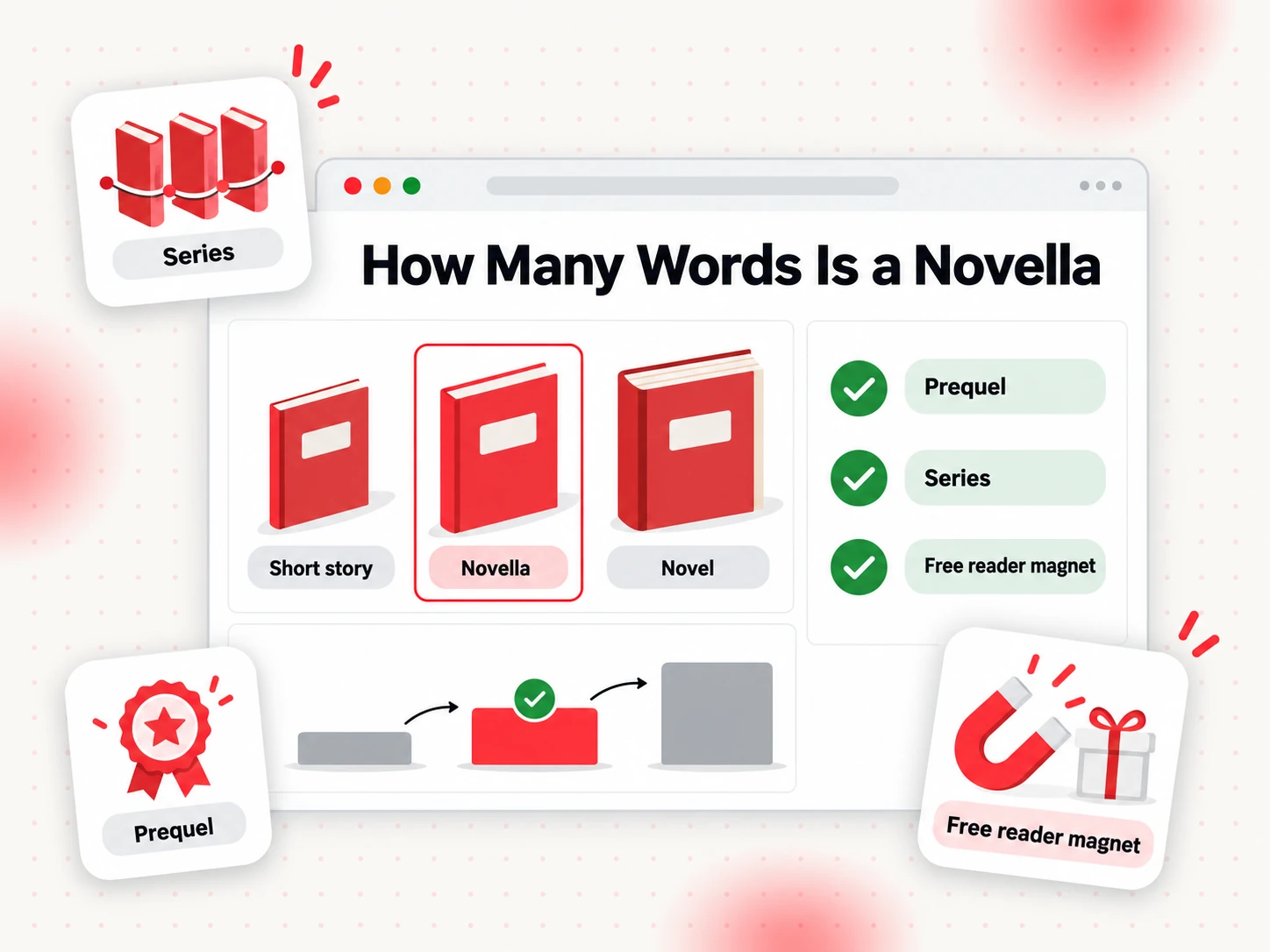
The boundaries matter less than the shape. A novella has the single-line plot of a short story and the room for character that a short story lacks. It usually follows one protagonist through one change over a short stretch of time, with few subplots. If your idea needs several viewpoints, a long timeline or parallel plots, it wants novel length. If it is one situation, one decision and one consequence, a novella may be the better container.
Self-published authors use novellas in a few practical ways:
- A prequel to a series. A short origin story gives readers a low-commitment start before the first full novel.
- A reader magnet. A short book given away or sold cheaply can introduce your voice and lead into a longer series.
- A series entry. Some genres, such as romance and cozy fiction, have readers who expect short, frequent instalments.
The same self-publishing guide makes the point from the market side: if your finished manuscript lands under about 40,000 words, you may be writing a novella and not a novel, and novellas suit serialized and series formats. If the story is complete, calling it a novella is more honest than padding it.
The print floor is also worth knowing. KDP paperbacks start at 24 pages and hardcovers at 75 (KDP print options). A 20,000-word novella is about 67 printed pages, so it can be a paperback but would fall short of the hardcover minimum. Whether it is also a good value for a reader is a pricing question, not a rules question.
How Many Words in a Book That Isn't Fiction?
Nonfiction has no genre convention for length. The honest answer to how many words in a book that is not fiction is: as many as it takes to deliver the promise on the cover, and typically 40,000 to 90,000 for a full-length book.
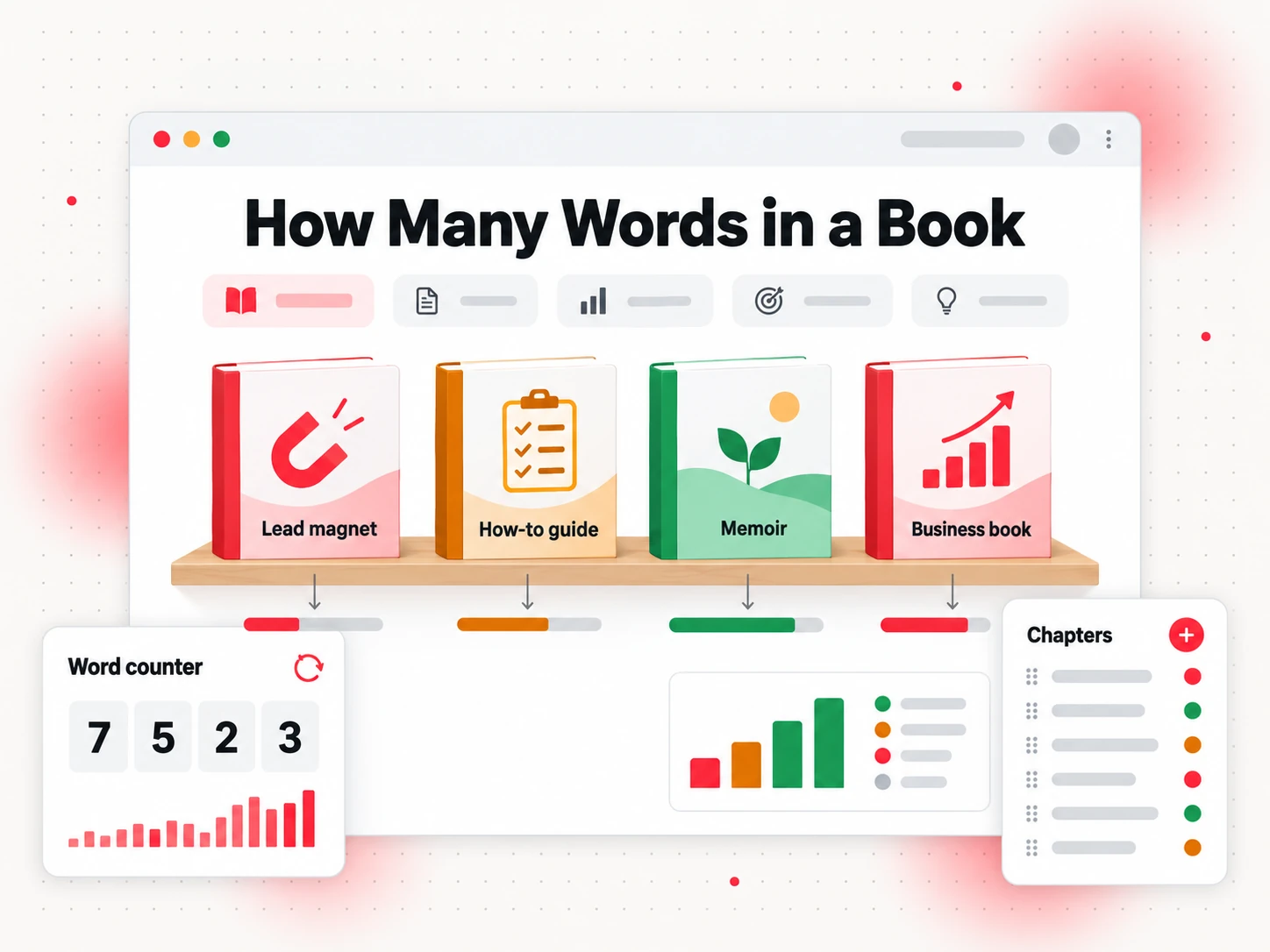
The sourced figures cover only part of the field:
- Memoir and narrative nonfiction. Writer's Digest gives memoir the same ideal range as a novel, 80,000 to 89,999 words, and calls 70,000 to 99,999 acceptable. Mushens Entertainment gives narrative nonfiction and memoir 60,000 to 90,000. The selfpublishing.com guide agrees with that lower range.
- Self-help. The same guide lists 40,000 to 70,000 words for self-help. That is one source, so treat it as an orientation point.
- Lead magnets and short guides. No agent or publisher sets a standard, because these books are not sold through the same channels. A lead magnet is judged by whether a reader gets one clear result quickly.
The way to set a nonfiction length is to work backwards from the reader's problem. A how-to guide that teaches one skill needs the steps, the reasons behind them, a worked example and a fix for the common mistakes. When that is done, it is done. A business book that argues a thesis needs enough evidence and cases to make the argument stick, and no more. A memoir needs enough scenes for the reader to feel the change in the narrator, which is why its range sits so close to the novel's.
The usual mistake is padding. A 25,000-word practical guide that does its job is a better book than a 60,000-word one that repeats itself to look substantial.
For the general process of planning and drafting a full-length book, see the guide to how to write a book.
Word Count for Debut Novels vs Self-Published Novels
A debut novel sent to agents and publishers should usually sit between about 70,000 and 100,000 words, while a self-published novel has no entry gate and is limited only by reader expectations and printing cost. The two routes use the same count for different reasons.
For agents and publishers, word count is a signal. Mushens Entertainment says word count is rarely a dealbreaker but that submissions of 200,000 words or more do ring alarm bells, because they suggest the book has not been edited or has pacing and structural problems. The agency also says its shortest signed adult debut was 55,000 words (later expanded to 95,000 after editing) and that its longest was around 160,000 words in epic fantasy. A 2007 Writer's Digest article quotes an agent who found a first-time novelist's book much easier to market between 80,000 and 100,000 words. The practical reading is that a first book outside its genre range gives an agent a reason to say no before reading page one.
For self-publishing, word count is a product decision. No one at the gate rejects a 45,000-word or a 160,000-word novel. KDP's print specifications set page limits, not word limits, as the earlier section showed. But three forces still apply:
- Reader expectations. A reader who buys a book expecting a full novel and gets a short one tends to say so in a review. That guide warns that landing outside the genre range costs reviews and, through them, sales.
- Printing cost. Print cost grows with page count. On amazon.com, a standard-trim black-ink paperback of 110 to 828 pages costs a $1.00 fixed fee plus $0.012 per page (KDP printing cost). At about 300 words a page, a 60,000-word book (200 pages) costs about $3.40 to print and a 100,000-word book (333 pages) costs about $5.00. The difference comes straight out of your royalty at the same list price.
- Series logic. A short first book can work as a low-risk entry to a series. A long one raises the price you have to charge.
If you are weighing the self-publishing route in general, the beginner's guide to Amazon KDP and the walkthrough on how to publish a book on Amazon cover accounts, formats and the upload steps.
If you are querying agents, aim at your genre range and treat its top as a ceiling. If you are self-publishing, choose the length that fits the story and your price, and make sure the book matches what the cover and blurb promise.
How to Check Your Novel Word Count
Check your novel word count in the writing app you already use, then cross-check it with a separate counter before you quote it to anyone. Different tools count hyphens, em dashes and headings differently, so two numbers from two tools can differ by a few hundred words.
Where to find the count in common tools:
- Microsoft Word. Word shows the count in the status bar near the lower-left corner of the window. For the detail, select Word Count on the Review tab, which also gives pages, paragraphs and characters and lets you include text boxes, footnotes and endnotes (Microsoft Support).
- Google Docs. Choose Tools, then Word count. The Docs help page also lets you display the count while you type in the bottom-left corner of the document (Google Docs Help).
- Scrivener. Choose Project, then Statistics for words, characters and more. Project, then Show Project Targets lets you set a word target for the whole draft (Literature & Latte).
For a count you can compare and keep, paste a chapter or a whole manuscript into the word counter. It shows the words, characters, sentences and paragraphs, splits the total into chapters when your headings sit on their own lines, and turns the count into a page estimate and a reading time. The page size is a choice between 250, 300 and 500 words per page, so you can match the manuscript-page and printed-page conversions above. The tool is free, needs no sign-up, and counts in your browser, so the text is not sent anywhere.
Chapter totals are the part that helps most with planning. An 80,000-word novel in 30 chapters averages about 2,700 words a chapter. Seeing the actual distribution shows you which chapters are fat and which are thin. If you have not yet planned the structure, the guide to outlining your novel chapter by chapter shows how to assign a target length to each part before you write it.
If you write in Bookeen AI online book creator, which turns an idea into a full manuscript, exports EPUB, PDF and DOCX files and includes a Novel template (see novel ebooks), the planned length is only a target. Paste the finished text into the word counter to get the real figure. Bookeen bills in pages, with one credit covering about one page of roughly 400 English words. That is its own measure of generated text, not a printed page, which holds about 300 words in a typical paperback. An 80,000-word novel is therefore about 200 Bookeen pages and about 270 printed pages.
What to Do If Your Novel Is Too Long or Too Short
If your novel is too long, cut scenes before you cut sentences. If it is too short, add story before you add words. The goal in both cases is a book that fits its genre because its structure is right, not one that hits a number.
When the draft is too long, work from the largest unit down:
- Merge or cut scenes that repeat what an earlier scene already did. Two scenes that both show a character is afraid are one scene too many.
- Remove a subplot that does not change the main plot's outcome. A subplot that can be deleted without anyone noticing the story broke is usually dead weight.
- Compress the opening. First drafts often spend many pages warming up before the real beginning. Start where the story starts.
- Split the book. If the draft has two complete arcs, publish two books, each with its own ending.
- Trim at the line level last. Cutting filler phrases tightens the prose but cannot fix a structural problem.
When the draft is too short, ask what the reader would miss:
- Deepen the main characters. Add the scenes that show what each one wants and fears.
- Add a real subplot. A second thread that complicates the first, such as a rival or a secret, adds length and tension together.
- Raise the stakes in the middle. Short drafts often lack a reversal where the hero's plan fails.
- Rebrand it honestly. If the story is complete at 35,000 words, publish it as a novella and price it as one.
The one thing not to do is pad. Description added to reach a number, scenes that stall the plot and repeated recaps all show. If you are racing the 50,000-word goal that National Novel Writing Month (NaNoWriMo) made famous, treat it as a first-draft milestone: 50,000 words is above SFWA's 40,000-word line but short of most adult genre ranges, so the draft will need more story in revision.
When you finish a revision, recount, and aim for a range rather than a point, such as 78,000 to 85,000 words.
How Many Words in a Novel FAQs
How many words are in a novel?
How many words in a novel has two answers: a novel is 40,000 words or more by SFWA's definition (SFWA), and most published adult novels run 70,000 to 100,000 words, with 80,000 to 89,999 the range Writer's Digest calls ideal for commercial and literary fiction (Writer's Digest, 2016). The novel word count is the total number of words in the text, and it depends slightly on the tool, since Word, Google Docs and Scrivener treat hyphens, em dashes and notes differently. Fantasy and science fiction run longer, up to about 125,000 words, and young adult books run shorter, from about 50,000 to 80,000. See the genre table above for the full list.
Is 50,000 words a novel?
By SFWA's definition, yes, because the novel category begins at 40,000 words. In practice, 50,000 words is short for adult genre fiction and a draft at that length usually needs more story in revision. For context, Mushens Entertainment says its shortest signed adult debut was 55,000 words.
How many pages is 80,000 words?
About 270 printed pages at 300 words per page, or about 320 double-spaced manuscript pages at 250 words per page. Both are estimates, because trim size, type size, line spacing and dialogue density all change the page count.
What is the minimum word count for a novel?
There is no legal minimum, but 40,000 words is the usual formal line: SFWA starts its novel category there (SFWA), while a 2007 Writer's Digest article put the bottom of the novel range at 55,000 (Writer's Digest, 2007). For a book you plan to send to agents, 70,000 words is a safer floor.
How many words is a novella compared with a novel?
A novella is 17,500 to fewer than 40,000 words, and a novel is 40,000 or more (SFWA). A novella is therefore at most about half the length of a typical 80,000-word novel, and it usually carries one plot and one viewpoint.
Is 120,000 words too long for a first novel?
It depends on the genre. For literary, romance or mystery, 120,000 words is above the usual 70,000 to 100,000 range and may count against you with agents. For fantasy, science fiction and historical fiction it sits inside or near the normal range: Mushens puts historical fiction at 100,000 to 120,000 and epic fantasy at 120,000 to 150,000 or more. Submissions of 200,000 words or more are the ones agents flag.
Do word count rules apply to self-published books on Amazon KDP?
No. KDP's print specifications set page limits, not word counts: paperbacks from 24 to 828 pages depending on trim size and ink, and hardcovers from 75 to 550 pages (KDP print options). Readers still expect a book to match its genre, and printing cost rises with page count. The beginner's guide to Amazon KDP covers the rest of the publishing process.
Ready to turn your idea into a finished manuscript and check its length against these ranges? Start writing with Bookeen AI online book creator, export your draft, and run the final text through the word counter before you publish.